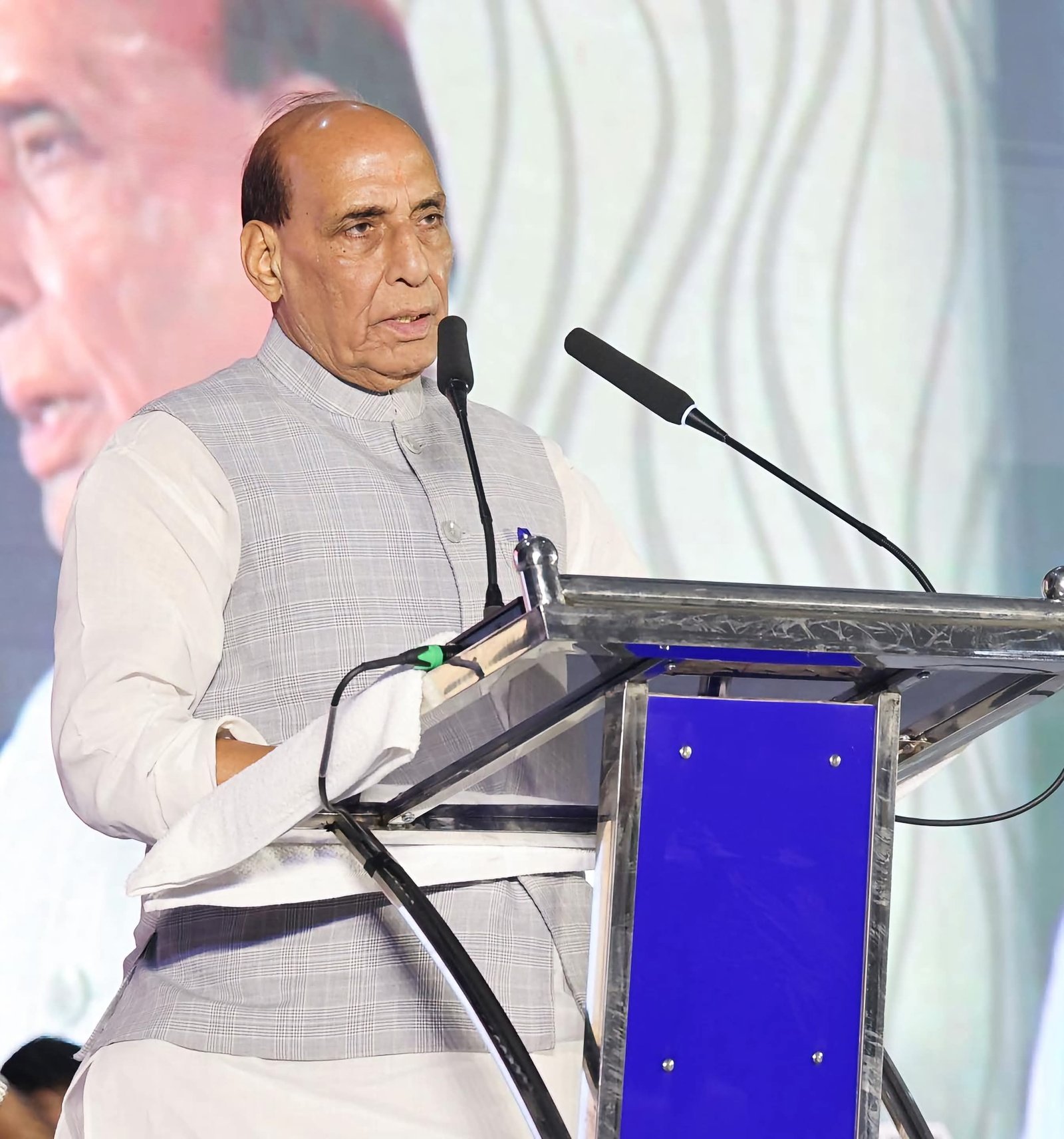
RAJNATH SINGH
“Democracy accords an inviolable right to dissent; it does not confer a licence to disseminate falsehoods, subvert constitutional institutions, or manufacture anarchy under the pretence of political resistance.”
An enduring maxim holds that truth is often the first casualty of war. Increasingly, however, this grim reality appears to have permeated the theatre of contemporary politics, where ideological contestation and the relentless pursuit of power are progressively being divorced from factual integrity. The phenomenon of post-truth politics has emerged as a formidable challenge to the intellectual integrity of public discourse. It describes an environment in which objective facts, verifiable evidence, and reasoned conclusions are subordinated to emotional manipulation, fabricated narratives, and strategically orchestrated misrepresentations. What was once largely confined to academic deliberations has now insinuated itself into the mainstream political arena. Through the systematic dissemination of misinformation and the propagation of contrived narratives, public opinion is not merely influenced; it is subjected to a sustained process of distortion. More insidiously, seeds of suspicion and institutional distrust are sown against the very constitutional edifices upon which democratic governance rests. Repetition lends falsehood the appearance of veracity, until manufactured perceptions begin to eclipse demonstrable reality. When this inversion becomes normalised, truth is not simply obscured; it is progressively dispossessed of its rightful place in the collective consciousness.
When certain leaders of the Congress and other opposition parties are accused of fomenting controversies, disseminating misleading claims, and aggravating political discord through unsubstantiated allegations, a fundamental question confronts the Indian democratic experience: has political competition begun to succumb to the corrosive imperatives of post-truth rhetoric? Undoubtedly, no constitutional institution is beyond legitimate scrutiny, nor should any government be insulated from rigorous questioning. Ideological plurality, principled disagreement, and political opposition are indispensable attributes of a vibrant democracy. Yet, these freedoms are accompanied by an equally consequential civic obligation: to subordinate partisan expediency, personal ambition, and transient electoral advantage to the enduring interests of the nation. This constitutes the moral compact underpinning democratic citizenship. When that compact is repudiated, the legitimate exercise of liberty risks degenerating into political irresponsibility. Consequently, the defence of truth, the scrutiny of evidence, and the repudiation of deliberate disinformation become imperatives of constitutional responsibility rather than mere instruments of political argument.
In recent years, opposition parties have repeatedly questioned the credibility of Electronic Voting Machines (EVMs) and the Election Commission of India’s administration of the Special Intensive Revision (SIR) of electoral rolls. In 2024, in Association for Democratic Reforms v. Election Commission of India, the Supreme Court declined to accept the demand for a return to the ballot-paper system in place of EVMs. The controversy nevertheless underscores a fundamental democratic principle: electoral processes must be scrutinised through verifiable evidence, technical examination, and legally established procedures. Questioning an electoral mechanism is not, in itself, inimical to democracy; indeed, reasoned scrutiny can strengthen public confidence. However, conjecture cannot be elevated to the status of conclusive evidence, nor can persistent insinuation substitute for substantiation. The legitimacy of electoral institutions is best safeguarded through transparency, accountability, and demonstrable procedural integrity—not through the indiscriminate perpetuation of suspicion.
The appointment of the Chief Election Commissioner and the integrity of electoral rolls raise equally consequential questions about institutional independence and constitutional accountability. The statutory selection framework provides for the participation of the Leader of the Opposition in the selection committee. Electoral-roll revision, meanwhile, has long formed part of India’s electoral administration. The Supreme Court has underscored the significance of accurate electoral rolls in securing free and fair elections, placing the responsibility for their accuracy, completeness, and integrity upon the Election Commission. The appropriate response to any allegation of irregularity, therefore, is impartial investigation, procedural transparency, and corrective action wherever warranted. To characterise an administrative exercise as evidence of a sweeping conspiracy without adequate substantiation risks generating unwarranted apprehension among citizens and eroding confidence in a constitutional process of exceptional national significance. Institutional credibility must neither be presumed infallible nor condemned through politically expedient conjecture; it must be assessed against evidence, constitutional obligations, and the rigour of due process.
The historical relationship between political authority and constitutional institutions in India offers further grounds for sober reflection. Before the first general election was held, the Constitution was amended to expand the permissible restrictions on freedom of expression. The Emergency remains one of the most disquieting chapters in the nation’s democratic history, marked by the curtailment of civil liberties and the suppression of constitutional freedoms. These episodes invite an enduring question: should the autonomy of institutions be judged according to whether their decisions serve the preferences of those wielding political power? The answer must be unequivocal. Constitutional independence cannot be contingent upon political convenience. The maturity of a democracy is measured by its willingness to respect institutional impartiality even when the outcomes are inconvenient, adversarial, or politically unwelcome. Constitutional institutions derive their legitimacy not from their conformity to partisan expectations, but from their fidelity to the law, procedural fairness, and impartial discharge of their mandates.
The perils of post-truth politics become particularly acute when questions of national security are drawn into partisan contestation. In 2019, statements made by Rahul Gandhi concerning the Rafale controversy, including his attribution of a claim to the Supreme Court, led to judicial scrutiny and an expression of unconditional regret. Other remarks concerning territorial security have likewise generated political controversy. The Opposition undoubtedly has a democratic responsibility to demand accountability from the government on matters of national security. Yet, such scrutiny must be anchored in factual precision, evidentiary integrity, and responsible public communication. Issues bearing upon national sovereignty and territorial security demand exceptional sobriety. Their deliberate exaggeration or misrepresentation for partisan advantage can impair public confidence, distort national debate, and compromise the responsible exercise of democratic accountability. Political disagreement is legitimate; the careless instrumentalisation of sensitive national concerns is not.
The distinction between dissent and anarchy is, therefore, not merely semantic; it is foundational to constitutional democracy. Dr. Bhimrao Ramji Ambedkar, the principal architect of the Indian Constitution, cautioned the Constituent Assembly against abandoning constitutional methods when legitimate avenues for democratic redress remained available. His celebrated warning concerning the “Grammar of Anarchy” remains a profound admonition against the normalisation of extra-constitutional methods in a constitutional polity. His argument was not an injunction against disagreement, protest, or criticism. Rather, it was a warning that the repudiation of constitutional means could imperil the democratic order itself. Dissent is the lifeblood of democracy, but its moral and constitutional legitimacy depends upon the means through which it is expressed. When disagreement becomes a vehicle for unsubstantiated allegations, deliberate disinformation, or the systematic delegitimisation of institutions without due regard for evidence, it risks departing from the very democratic principles it purports to defend.
A flourishing democracy must rest upon more than the formal equality of political participation. Social justice, economic equity, equal opportunity, and the protection of individual dignity are equally indispensable to its enduring legitimacy. The ultimate purpose of governance is to ensure that the benefits of development reach the most disadvantaged, that citizens’ rights remain inviolable, and that public institutions discharge their responsibilities within the constitutional framework. Grievances must be addressed through dialogue, deliberation, transparency, and lawful remedies. Institutional distrust cannot be constructively resolved by manufacturing suspicion, escalating confrontation, or normalising political disorder. Equally, the obligation to preserve public confidence cannot become an excuse to suppress legitimate criticism. A mature democracy must possess the intellectual confidence to withstand scrutiny and the constitutional discipline to distinguish evidence-based criticism from deliberate falsehood.
India’s democratic journey has reached a consequential juncture at which political competition must be reconciled with national responsibility. Criticism of those in power does not weaken democracy; when grounded in facts and advanced through legitimate constitutional channels, it strengthens accountability and improves governance. Conversely, manipulating public consciousness through falsehood, assailing constitutional institutions through unsubstantiated allegations, and allowing partisan resentment to overwhelm national priorities are practices fundamentally at odds with democratic maturity. The true measure of political statesmanship lies not in the intensity of denunciation, but in the integrity of argument, the restraint of public conduct, and an unwavering commitment to constitutional propriety.