
Two vaginal canals, two uteruses and a deeply personal journey—from adolescent uncertainty to love, marriage and becoming a mother. Kelly Miller’s story offers a rare insight into reproductive anatomy, emotional vulnerability and the importance of compassionate medical care.
Dainik India News New Delhi:
What happens when a young girl discovers that her body is different from what she had always assumed? For American woman Kelly Miller, that discovery came at the age of 15. A medical examination revealed that she had two uteruses and two vaginal canals, a rare congenital variation that prompted questions about her health, relationships and future. Years later, her experience of love, marriage and motherhood would add a deeply human dimension to a story that first began in a doctor’s examination room.
Kelly had experienced painful menstruation and unusually heavy bleeding from an early age. When the symptoms became increasingly difficult to manage, her mother took her for medical evaluation. The examination revealed an anatomical difference that Kelly had never expected. At an age when many teenagers are only beginning to understand their changing bodies, she was suddenly confronted with questions about reproductive health and what her diagnosis might mean for her future.
The discovery was more than a medical finding. It carried emotional uncertainty. Would she be able to build a relationship without fear of being misunderstood? Would her condition affect her chances of becoming a mother? Such concerns are not unusual for people who receive unexpected diagnoses involving intimate aspects of their bodies. Kelly’s experience highlights why healthcare professionals must communicate sensitive findings with empathy, clarity and respect.
Her personal life brought another challenge. In 2002, when she was 19, Kelly met the man who would later become her husband. Like anyone beginning a relationship, she hoped for affection, companionship and a future built on trust. Yet she initially felt hesitant about telling him about her anatomy. In an interview with ABC News, she explained that she had not disclosed her condition at the beginning because she worried that he might see her differently.
That hesitation reveals an important aspect of living with a rare congenital condition: the concern is not always physical discomfort, but also the possibility of stigma or rejection. The available report does not establish precisely when her husband learned about her condition or what he said in response. Her private conversations should therefore not be reconstructed as fact. What her experience does illustrate is the emotional importance of acceptance and honest communication in intimate relationships.
Despite earlier concerns about possible reproductive complications, Kelly later became pregnant and gave birth to two daughters. Her pregnancies involved medical care and monitoring. Her experience demonstrates that an unusual reproductive anatomy does not automatically mean that pregnancy is impossible; individual outcomes depend on the person’s specific anatomy and medical circumstances.
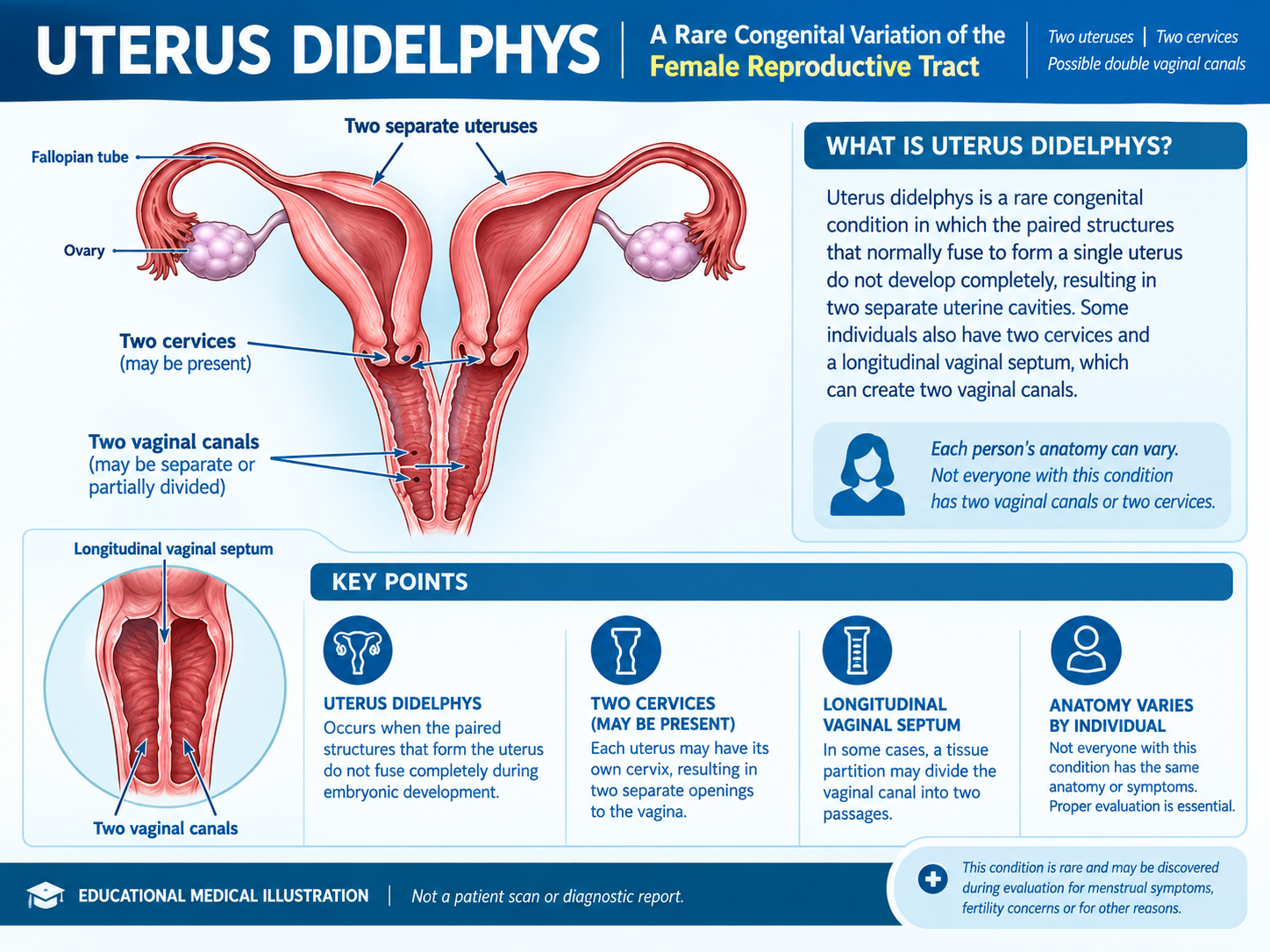
Clinically, a condition involving two uteruses is known as uterus didelphys. It occurs when the paired structures that ordinarily develop into a single uterus do not fuse completely during embryonic development. Some individuals also have two cervices and a longitudinal vaginal septum, which divides the vaginal canal into two passages. The exact anatomical presentation varies, and appropriate evaluation is essential.
For doctors, medical students and researchers, Kelly’s story offers a valuable reminder that reproductive health must be approached through both scientific understanding and human sensitivity. A rare anatomical finding should never define a patient’s identity or diminish their dignity.
Kelly Miller’s story is ultimately about more than the term “Double Vagina.” It is about confronting uncertainty, navigating intimate relationships and discovering that a congenital difference does not erase the possibility of love, family or a fulfilling life.